Poznań
Over the past few months we’ve been collecting bits and pieces of our Dad’s family history. Our family ancestors were from what was Prussia, coming to Australia by boat in 1870.
Poland has gone through many changes, and records have been lost or destroyed. Nat found a researcher here in Poznań to help search available records, and to take us to visit the areas where our family lived.
It’s impossible to find actual homes even if they did still exist, however churches, town halls and cemeteries provided better opportunities. Our first stop north of Poznań was the small village of Murowana Goślina, where we found the church our great, great, great grandparents Johann and Anna Maria were married.
It’s quite surreal to stand in the place where your family lived so long ago and so far away. A whole other life to ours. A little further north is Skoki where they lived and where Julius, their fourth child, and our great, great grandfather was born.
Most Evangelical churches from Prussian times have fallen into disrepair or been demolished, with the land then used to build Catholic churches. We ran out of luck after Murowana Goślina. In Piła where Julius and his wife Juliane lived before they left for Australia we could only stand in an empty square and imagine the church where they’d married.
We visited several local towns and villages where our family members had ties, but perhaps the most entertaining visits of all were the cemeteries.
The first was in Oleśnica, a tiny dot on the map near Chodzież. All that was there was a grand manor where Johann had worked and was buried after his death. A man there saw us poking around and spoke rapid fire Polish to Lukasz for at least ten minutes. We waited, eager to hear what he’d had to say.
‘He said the cemetery is this way,’ Lukasz told us, before setting off into the forest. We were learning quickly that Lukasz was not one for conversation.
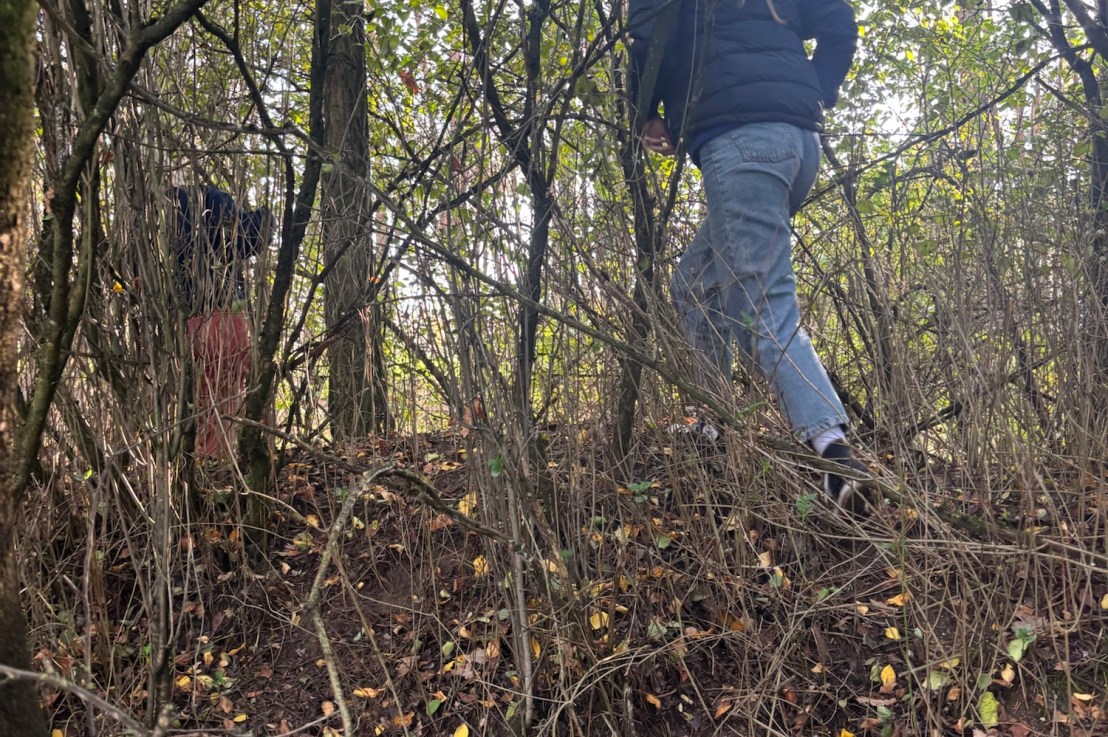
He forged ahead into the valley, paying little heed to us skidding down the muddy hill behind him, through the leaves and debris, into a wet ravine and clambering up the other side. It was obvious Lukasz was solely focused on finding the cemetery site. When we eventually caught up, muddy and covered in leaves, we found him standing in a flat mossy area with the sunken holes of old crypts. An unmarked graveyard abandoned and forgotten, but somehow beautiful with the sunbeams shooting through the trees and hitting the bright green moss. Somewhere here lay Johann.
The second cemetery was in Romanowo Górne, where Juliane lived and where her parents Gottlieb and Wilhelmina were buried. Again the Lutheran cemetery was left abandoned and a new Catholic church and cemetery established nearby.
By this time it seemed Lukasz had forgotten we even existed. He was off into the scrub, and we valiantly dived in after him.
There was no path, just more spindly trees, moss and muddy slopes.
Peppa received a message from her dad back in London while we were traipsing through the bushes ‘Where are you?’ to which Peppa replied ‘No idea’ and sent him a picture of the empty forest.
‘Serial killer territory,’ he responded, and went back to his beer. Peppa went back to crashing through the forest.
This site was a tangled mess of trees. At one point I grabbed hold of an unattached branch to steady myself, fell backwards, caught my ponytail hard and fast in the trees behind me, spent five minutes figuring out what exactly I’d done to myself and another 10 minutes trying to set myself free. I’m not sure crashing through the bushes looking for an abandoned gravesite is the ideal European holiday for a 23 year old, but Peppa certainly enjoyed that moment.
There was even less evidence of a cemetery here; some old stones markers and a few scattered boulders. Gottlieb and Wilhelmina’s last resting place.
It was a fascinating day, and we will go home knowing we’ve experienced the churches, graveyards and town squares of our Prussian ancestors.
And a little more of the Polish countryside than we’d anticipated.